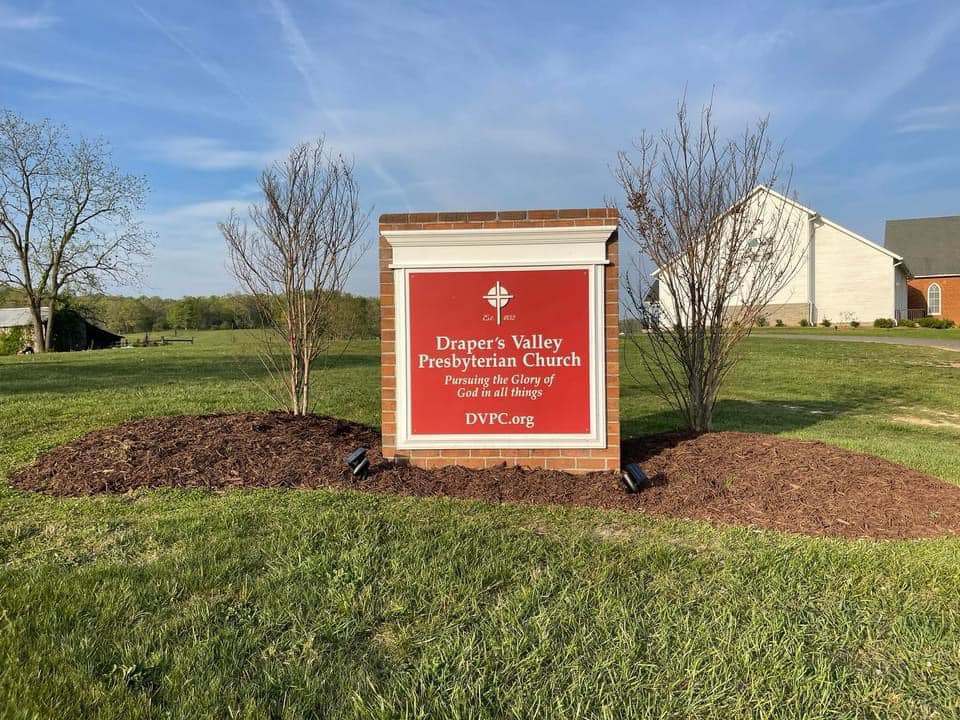
Draper’s Valley Presbyterian Church finds its roots in the Old Harmony congregation of Southeastern Wythe County. In 1808, a group of believers from various denominations purchased a parcel of land overlooking the New River. There they erected a building that was used for services, and also for education. The minister also served as schoolmaster for the children from nearby farms. For a number of years, members of four denominations worshipped together at Old Harmony: Presbyterians, Methodists, Baptists, and Disciples of Christ.
In 1832, the Presbyterians, under the Reverend Mr. George Painter, separated and formed their own congregation in Pulaski County, not far from the Wythe County line. In 1837, the Presbyterian Church (USA) suffered a schism between the more doctrinally rigid Old School and the more progressive New School, and Draper’s Valley affiliated with the New School denomination.
The current sanctuary was erected shortly thereafter, in 1840. It is constructed of hand-made red brick of native clay. Shortly thereafter, the Old and New School Presbyterian churches reunited, to be rent asunder during the Civil War, in which time the church affiliated with the Presbyterian Church (Confederate States of America), which, after the cessation of hostilities assumed the name, the Presbyterian Church in the United States, and was informally known as the Southern Presbyterian Church.
In 1874, the Reverend Mr. George H. Gilmer, Sr. became pastor. In 1872, the Draper’s Valley Academy was built, and Mr. Gilmer became the principal instructor. The school served to provide local children with a rigorous and Biblical education, until it was later subsumed into the Pulaski County Schools. In 1896, Mr. Gilmer’s son, George H. Gilmer, Jr. became pastor.
The Reverend Dr. Preston Orr Sartelle, Sr. was called to be pastor in 1942. Shortly thereafter he was called into the Marines to serve as a chaplain in World War II. At that time, the Presbyterian church demanded that all its pastors heeding the call to become chaplains must resign their churches. Dr. Sartelle submitted his resignation to the clerk of the session (governing board of the church), but it was never acted upon. Dr. Sartelle resumed his pastoral duties after the war, and served until 1957. Both Dr. Sartelle’s son, Preston O. Sartelle, Jr., and son-in-law, Cortez A. Cooper, Jr., have served as pastors of the congregation. All five of Preston and Mary Ellen Sartelle’s children served in the gospel ministry –their three sons serving as ministers in the Presbyterian Church in America, and two daughters married to Presbyterian ministers.
In 1983, concerned at the increasing centralization and liberalism in the Southern church, as well as its impending merger with the larger and more progressive (Northern) Presbyterian Church (USA), many Southern churches, including Draper’s Valley, left the old denomination and affiliated with the Presbyterian Church in America, which had been founded in 1973, to be “faithful to the Scriptures, loyal to the Reformed faith, and obedient to the Great Commission.” Draper’s Valley is one of two churches in the county affiliated with the PCA, the other being Pulaski Presbyterian.
To the original sanctuary were added two educational additions, in 1948 and 1954. In 1990, a beautiful and functional fellowship hall was added, which beautifully complements the original rooflines and red brick facade. The sanctuary has been updated through the years, but still retains its original simple country charm.
By the grace of God, the church has continued to prosper and grow. Due to space limitations, a second morning service was added in 2001.
The church maintains an active program, with Sunday evening services and a midweek family night, as well as active women’s, men’s, and children’s discipleship programs.
In 2007, the church celebrated its 175th anniversary.
History of Draper’s Valley Presbyterian Church
Abridged and Adapted from Miss Sydney Painter’s History
Draper’s Valley Presbyterian Church finds its roots in the Old Harmony Congregation of Southeastern Wythe County. In 1808, a group of believers from various denominations purchased a parcel of land overlooking the New River. The minister also served as schoolmaster for the children from nearby farms. For about 24 years, members of four denominations worshipped together at Old Harmony: Presbyterians, Methodists, Baptist, and Disciples of Christ.
In the late 1820’s, a young Presbyterian minister, the Rev. George Painter, of Tennessee TheologicalCollege joined the church group. He also worked in other Presbyterian churches in Pulaski and WytheCounty.
In 1832 Painter organized his 57 followers into a new church, as a congregation of the New School party in the Presbyterian Church (USA). They obtained land from a Harvey Shepherd, who lived about one-half mile from the Wythe County line, and, in 1840, built the Draper’s Valley Presbyterian Church of brick made from the native clay. They also built a two-room school house on the east side of the church (no longer standing). A year later, Painter, using the same home-made brick, built a home for himself about one mile north of the church. Both the church and the house still stand and are in good condition.
The building, having large double doors, faces the South. There were two large square windows of clear glass at each end of the church and three windows on either side. Over the front doors is a large wheel-shaped window. The first change to be made was to close the two windows behind the pulpit. All other windows had arches built over them and the clear glass was replaced with frosted glass. At the same time, a steeple was built over the front. The original small vestibule, used for session meetings and Sunday School rooms has been changed to enlarge the vestibule. The balcony staircase is found here. The pulpit was in the north end of the sanctuary and was graced by three beautiful hand-crafted chairs, cushioned in red velvet. These chairs are still in use today. In the early days, three rows of home-made benches filled the interior of the sanctuary. The benches on the west side of the sanctuary were occupied by men and boys, and those on the east by women and girls. The center benches were reserved for families.
There are two original beautiful chandeliers extending from the ceiling, each holding four oil lamps. In the 1930’s, when electricity came to the valley, these chandeliers were wired and fitted for bulbs. They are still used today.
To the original sanctuary were added two educational additions, under the pastorate of Rev. Preston O. Sartelle, Sr., in 1949 and in 1954. In 1990, a beautiful and functional fellowship hall was added, which beautifully complements the original rooflines and red brick façade.
Throughout the years, the church has been affiliated with the New School Presbyterian Church, the Presbyterian Church (USA), the Presbyterian Church (Confederate States of America), and the (Southern) Presbyterian Church (US). In 1982, in light of the impending merger between the Southern and Northern Presbyterian Churches, the church voted to affiliate with the Presbyterian Church in America, an evangelical denomination “faithful to the Scriptures, loyal to the Reformed faith, and obedient to the Great Commission.”
2755 Old Baltimore Road • Draper, VA 24324
Office: 540-994-9015